Exam Discount APMG-International AgilePM-Practitioner Voucher, AgilePM-Practitioner Study Center
Wiki Article
P.S. Free 2026 APMG-International AgilePM-Practitioner dumps are available on Google Drive shared by BraindumpsPass: https://drive.google.com/open?id=1HNJ0SWsr6mghGkOABLMq37XnFd4ykuMO
The best news is that during the whole year after purchasing, you will get the latest version of our AgilePM-Practitioner exam prep for free, since as soon as we have compiled a new version of the study materials, our company will send the latest one of our AgilePM-Practitioner study materials to your email immediately. And you will be satisfied by our service for we will auto send it to you as long as we update them. If you have to get our AgilePM-Practitioner learning guide after one year, you can still enjoy 50% discounts off on the price.
APMG-International AgilePM-Practitioner Exam copyright Topics:
| Topic | Details |
|---|---|
| Topic 1 |
|
| Topic 2 |
|
| Topic 3 |
|
| Topic 4 |
|
>> Exam Discount APMG-International AgilePM-Practitioner Voucher <<
AgilePM-Practitioner Study Center - Latest Real AgilePM-Practitioner Exam
For your information, the passing rate of our AgilePM-Practitioner study questions is over 98% up to now. Up to now our AgilePM-Practitioner practice materials consist of three versions, all those three basic types are favorites for supporters according to their preference and inclinations. On your way moving towards success, our AgilePM-Practitioner Preparation materials will always serves great support. And you can contact us at any time since we are serving online 24/7.
APMG-International Agile Project Management (AgilePM) Practitioner Exam Sample Questions (Q113-Q118):
NEW QUESTION # 113
Column 1 is a list of actions taken within the project. For each action in Column 1, select from Column 2 the iterative development activity that the action represents. Each selection from Column 2 can be used once, more than once or not at all.
Column 1:
1.The Solution Development Team cleared and prepared the area, ready for the bar infrastructure to be installed.
2.The Gardener decided the order in which the flowers would be planted in the borders and jotted it down in a notebook.
3.Before the Solution Development Team built the infrastructure for the bar area, the Architect pointed out what was required.
4.The Architect checked with the decorators that tasks had been completed to a satisfactory standard, and agreed a list of items that needed further coats of paint or cleaning up.
5.The Gardener began planting the borders and has placed an order for further bulbs to complete this task.
Column 2:
A) Thought
B) Action
C) Conversation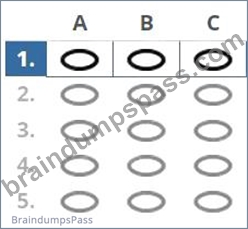
Answer:
Explanation: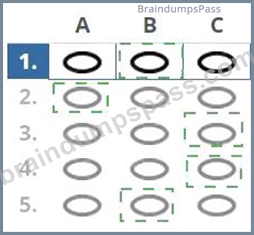
Explanation:
For each action in Column 1, here is the iterative development activity that the action represents from Column
2:
* The Solution Development Team cleared and prepared the area, ready for the bar infrastructure to be installed.
* B. Action
* The Gardener decided the order in which the flowers would be planted in the borders and jotted it down in a notebook.
* A. Thought
* Before the Solution Development Team built the infrastructure for the bar area, the Architect pointed out what was required.
* C. Conversation
* The Architect checked with the decorators that tasks had been completed to a satisfactory standard, and agreed a list of items that needed further coats of paint or cleaning up.
* C. Conversation
* The Gardener began planting the borders and has placed an order for further bulbs to complete this task.
* B. Action
NEW QUESTION # 114
Using the additional information provided for this question in the Scenario Booklet, answer the following question about the actions the Sales Director should take to develop an effective Sales management team, according to the five dysfunctions that characterize an ineffective team identified by Patrick Lencioni.
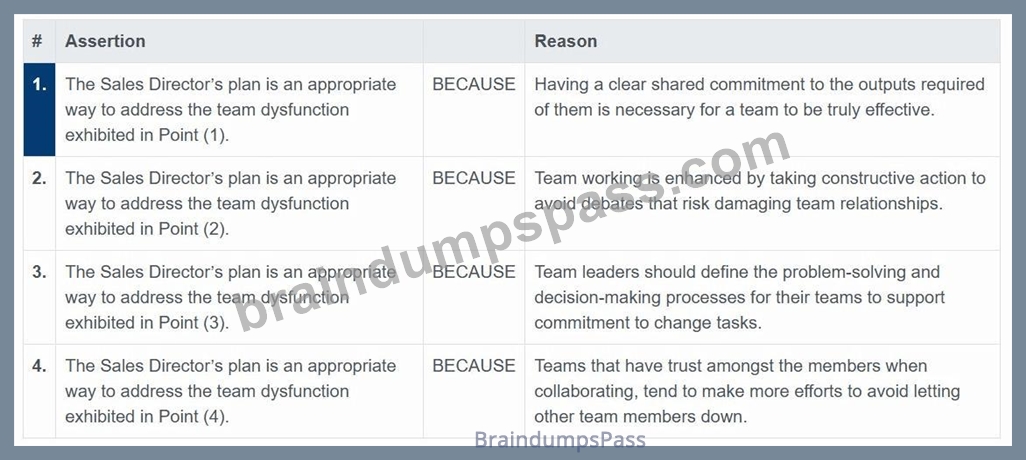
Lines 1 to 4 in the table below consist of an assertion statement and a reason statement. For each line identify the appropriate option, from options A to E, that applies.
Each option can be used once, more than once or not at all.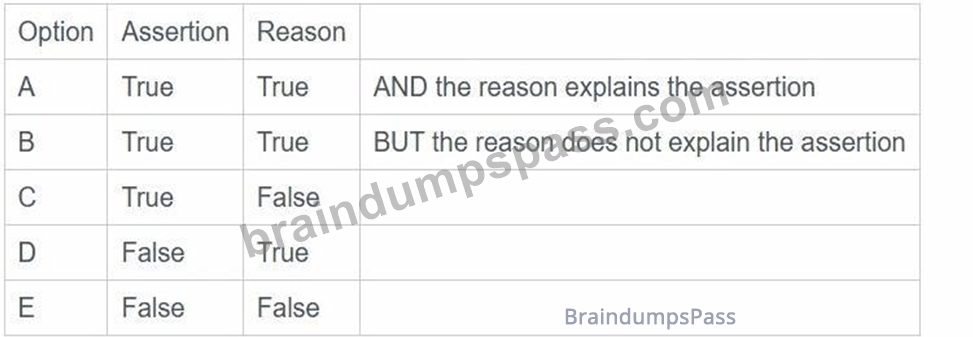
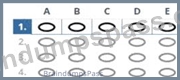
Answer:
Explanation: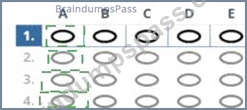
Explanation:
Comprehensive and Detailed Step-by-Step Explanation:
1. Assertion: The Sales Director's plan is an appropriate way to address the team dysfunction exhibited in Point (1).
Reason: Having a clear shared commitment to the outputs required of them is necessary for a team to be truly effective.
* Analysis: Patrick Lencioni ' s first dysfunction is the absence of trust . Point (1) outlines issues of commitment due to internal conflicts and lack of alignment. The Sales Director's plan addresses these issues by bringing the team together for a shared vision and commitment . This ensures clarity of expectations and alignment.
* Since the assertion and reason are true and explain the behavior, the correct answer is A .
2. Assertion: The Sales Director's plan is an appropriate way to address the team dysfunction exhibited in Point (2).
Reason: Team working is enhanced by taking constructive action to avoid debates that risk damaging team relationships.
* Analysis: Dysfunction (2) addresses fear of conflict . The Sales Director plans to clarify individual roles and responsibilities. This proactive action avoids unnecessary debates about overlapping work and ensures constructive conflict resolution , essential for building relationships.
* Since the assertion and reason are true and explain the behavior, the correct answer is A .
3. Assertion: The Sales Director's plan is an appropriate way to address the team dysfunction exhibited in Point (3).
Reason: Team leaders should define the problem-solving and decision-making processes for their teams to support commitment to change tasks.
* Analysis: Point (3) highlights a lack of accountability , one of the dysfunctions. The Sales Director's plan acknowledges unfulfilled tasks and seeks joint agreement on future actions. This creates structured accountability by defining processes and ensuring follow-through on commitments.
* Since the assertion and reason are true and explain the behavior, the correct answer is A .
4. Assertion: The Sales Director's plan is an appropriate way to address the team dysfunction exhibited in Point (4).
Reason: Teams that have trust amongst the members when collaborating, tend to make more efforts to avoid letting other team members down.
* Analysis: Dysfunction (4) is inattention to results . Point (4) highlights resistance to adopting the required changes for selling mobile applications. The plan to cross-collaborate with other departments builds trust and understanding among team members, ensuring shared accountability for results.
* Since the assertion and reason are true and explain the behavior, the correct answer is A .
References:
Patrick Lencioni ' s Five Dysfunctions of a Team : A Leadership Fable.
Analysis of team collaboration and management strategies applied to organizational development.
NEW QUESTION # 115
(New food hygiene laws take effect in six months. Sukra Aroon and Wanida Anong are assessing if kitchen remodeling is needed, which may divert Infrastructure Team resources.)
- A. VUCA-based, because new legislation is an external factor requiring adaptability to respond to unplanned demands.
- B. Approach-based, because Sukra Aroon should have tracked evolving legislation from the start to mitigate the risk.
- C. VUCA-based, because gaps in internal compliance cause uncertainty in responding to changing regulations.
- D. Approach-based, because past Project Increment planning failed to account for regulatory change, causing lack of contingency and resource risks.
Answer: A
Explanation:
The correct answer is C .
In AgilePM, VUCA-based risks are those driven by external volatility, uncertainty, complexity, or ambiguity in the environment. New legislation is a classic example of this because it originates outside the project and can force reprioritization, redesign, resource shifts, and rapid adaptation.
In this scenario, the new food hygiene laws are:
* external to the project ,
* time-bound , since they take effect in six months,
* and capable of creating unplanned work , such as kitchen remodeling and resource diversion.
That makes this a VUCA-based risk , not an approach-based one.
Why C is correct:
The key reason is that the trigger is new legislation , which is an environmental change outside the project team's control. AgilePM recognizes that such external changes can emerge during delivery and require the project to remain adaptable.
The possible impact here includes:
* reassessing scope,
* reassigning Infrastructure Team capacity,
* reviewing compliance obligations,
* and potentially adjusting delivery priorities.
That is exactly the kind of situation where AgilePM's flexibility is valuable.
Why the other options are incorrect:
A). Approach-based, because past Project Increment planning failed to account for regulatory change, causing lack of contingency and resource risks.
This is not the best answer because the scenario does not say the team negligently ignored a known requirement. The key issue is the emergence of new laws , which is primarily an external uncertainty rather than a failure of method.
B). Approach-based, because Sukra Aroon should have tracked evolving legislation from the start to mitigate the risk.
This is also not the best answer. Even though compliance awareness is important, the fundamental source of the risk is still the external regulatory change , not simply Sukra's handling of it.
D). VUCA-based, because gaps in internal compliance cause uncertainty in responding to changing regulations.
This is weaker than C because it shifts the cause toward an internal gap. The scenario itself emphasizes the introduction of new food hygiene laws , which is the main source of uncertainty and disruption.
AgilePM perspective:
AgilePM is designed to help teams respond to changing external conditions without losing focus on business value. Regulatory changes often require:
* rapid reassessment,
* collaborative decision-making,
* flexible reprioritization,
* and attention to compliance without abandoning the overall project goals.
Since this risk is caused by external legislation , the correct classification is VUCA-based .
Therefore, the best answer is C .
NEW QUESTION # 116
During the Foundations phase for Project Increment 4, Sukra Aroon held a meeting with Hira, Mira Bachar, andWanida Anong, to ensure alignment and compliance with EPR company policies, local regulations, and international standards. The meeting also clarified how financial and investment decisions would be made for Project Increment 4, ensuring alignment with EPR business priorities, and how this information will be tracked, controlled and evidenced.
Wanida Anong, who works across multiple sites worldwide, attended the meeting in person but has limited availability throughout the Project Increment.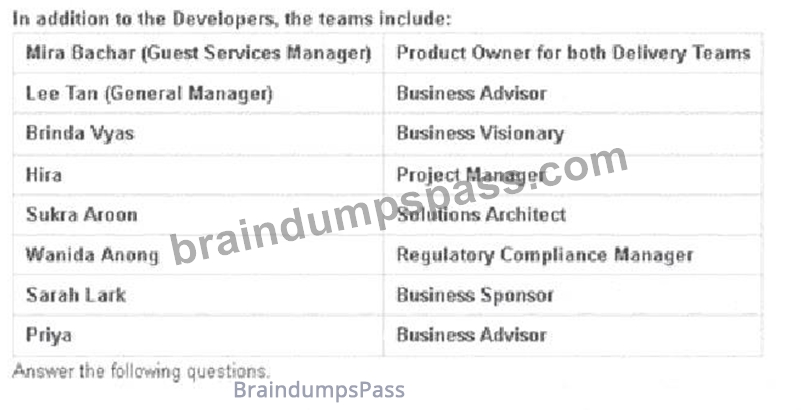
(During the meeting, Mira Bachar shared a query raised by Lee Tan. Lee has questioned how a business case can exist without a detailed understanding of exactly what will be delivered.
Which of the following is an appropriate explanation?)
- A. AgilePM business cases are based on a fixed scope, detailed upfront analysis and estimates. This approach is structured to reduce uncertainty by ensuring all major deliverables are accounted for from the start.
- B. The business case in AgilePM uses incremental funding, adjusting investments as project priorities evolve and allowing the project to remain adaptable while still providing financial predictability.
- C. AgilePM maximizes output efficiency, delivering complete, goal-aligned value on an incremental basis.
- D. In AgilePM, the business case focuses on project goals and benefits, using MoSCoW to ensure value delivery within fixed time and cost. This provides flexibility while maintaining control over investment.
Answer: D
Explanation:
The correct answer is A .
In AgilePM, the business case does not depend on having a fully fixed and detailed scope from the start.
Instead, it is based on:
* the business need ,
* expected benefits ,
* viability,
* and confidence that sufficient value can be delivered within agreed constraints.
Why A is correct:
* It correctly explains that AgilePM focuses on goals and benefits , not exhaustive detail upfront.
* It also correctly brings in MoSCoW prioritization , which helps ensure that the most important value is delivered first within fixed time and cost.
* This allows flexibility in lower-priority scope while maintaining investment control.
Why the other options are incorrect:
* B introduces incremental funding in a way that is not the core explanation here.
* C describes a predictive, fixed-scope model rather than AgilePM.
* D is too vague and does not directly explain how a business case can exist without detailed delivery certainty.
So the best answer is A .
NEW QUESTION # 117
During the Foundations phase for Project Increment 4, Sukra Aroon held a meeting with Hira, Mira Bachar, andWanida Anong, to ensure alignment and compliance with EPR company policies, local regulations, and international standards. The meeting also clarified how financial and investment decisions would be made for Project Increment 4, ensuring alignment with EPR business priorities, and how this information will be tracked, controlled and evidenced.
Wanida Anong, who works across multiple sites worldwide, attended the meeting in person but has limited availability throughout the Project Increment.
(On receiving the meeting invitation, Hira responded suggesting that Brinda Vyas should also be invited to the meeting. Based on AgilePM guidance, which of the following does NOT present an appropriate justification for Brinda Vyas ' attendance?)
- A. The understanding of regulatory compliance needs for the Eco-spa gained by attending the meeting will help Brinda Vyas keep business stakeholders aligned with the business solution as it emerges.
- B. Brinda Vyas is accountable for the financial and regulatory governance aspects of the project and must personally oversee compliance-related discussions to ensure standards for these are met.
- C. Brinda Vyas plays a key role in confirming that the regulatory and quality expectations being discussed are aligned with the business need and will not undermine the viability of the project.
- D. Brinda Vyas is responsible for ensuring that the solution aligns with the strategic direction of the business and provides the expected value. Her input will help shape decisions related to capital investment.
Answer: B
Explanation:
B does not align with AgilePM role responsibilities.
Brinda Vyas, as the Business Visionary , is responsible for ensuring the evolving solution remains aligned with the business vision, business need, and expected value. She is an important stakeholder in discussions where compliance, quality, and investment choices may affect viability or business outcomes.
However, AgilePM does not make the Business Visionary personally accountable for financial governance and regulatory governance in the way option B states. Those concerns are shared across other roles, such as:
* the Business Sponsor for investment and business justification at the highest level,
* the Project Manager for governance coordination and control,
* and specialist roles such as Wanida Anong for compliance expertise.
Why the other options are appropriate:
* A is appropriate because Brinda should help ensure decisions remain aligned with strategic direction and value.
* C is appropriate because Brinda should confirm that compliance and quality expectations do not undermine business viability.
* D is appropriate because attending helps Brinda maintain alignment among business stakeholders as the solution evolves.
So the statement that does not provide an appropriate justification is B .
NEW QUESTION # 118
......
BraindumpsPass offers up-to-date Agile Project Management (AgilePM) Practitioner Exam (AgilePM-Practitioner) practice material consisting of three formats that will prove to be vital for you. You can easily ace the Agile Project Management (AgilePM) Practitioner Exam (AgilePM-Practitioner) exam on the first attempt if you prepare with this material. The APMG-International AgilePM-Practitioner Exam Dumps have been made under the expert advice of 90,000 highly experienced APMG-International professionals from around the globe. They assure that anyone who prepares from it will get Agile Project Management (AgilePM) Practitioner Exam (AgilePM-Practitioner) certified on the first attempt.
AgilePM-Practitioner Study Center: https://www.braindumpspass.com/APMG-International/AgilePM-Practitioner-practice-exam-dumps.html
- Pass Guaranteed Quiz APMG-International - Professional AgilePM-Practitioner - Exam Discount Agile Project Management (AgilePM) Practitioner Exam Voucher ???? Search for ☀ AgilePM-Practitioner ️☀️ and easily obtain a free download on [ www.prepawayete.com ] ????Latest AgilePM-Practitioner copyright Sheet
- How To Improve Your Professional Skills By Achieving The APMG-International AgilePM-Practitioner Certification? ???? Easily obtain free download of ➥ AgilePM-Practitioner ???? by searching on ➤ www.pdfvce.com ⮘ ????AgilePM-Practitioner Exam Material
- New AgilePM-Practitioner Dumps Questions ???? Valid AgilePM-Practitioner Test Sims ???? Reliable AgilePM-Practitioner Test Pass4sure ???? Search on “ www.exam4labs.com ” for [ AgilePM-Practitioner ] to obtain exam materials for free download ????Valid AgilePM-Practitioner Test Sims
- AgilePM-Practitioner Valid Exam Test ???? Latest AgilePM-Practitioner Test Answers ???? AgilePM-Practitioner Latest Test Questions ???? Enter ➠ www.pdfvce.com ???? and search for ➽ AgilePM-Practitioner ???? to download for free ????Interactive AgilePM-Practitioner Practice Exam
- Valid AgilePM-Practitioner Test Sims ✊ Latest AgilePM-Practitioner Test Answers ???? AgilePM-Practitioner Flexible Learning Mode ???? Open 「 www.exam4labs.com 」 and search for ➠ AgilePM-Practitioner ???? to download exam materials for free ????New AgilePM-Practitioner Dumps Questions
- Free PDF APMG-International - AgilePM-Practitioner - Efficient Exam Discount Agile Project Management (AgilePM) Practitioner Exam Voucher ???? Search on ▶ www.pdfvce.com ◀ for ⏩ AgilePM-Practitioner ⏪ to obtain exam materials for free download ????Latest AgilePM-Practitioner copyright Sheet
- 2026 Accurate Exam Discount AgilePM-Practitioner Voucher | 100% Free Agile Project Management (AgilePM) Practitioner Exam Study Center ???? Search for ☀ AgilePM-Practitioner ️☀️ and download it for free on ▛ www.practicevce.com ▟ website ????Reliable AgilePM-Practitioner Exam Camp
- High-quality Exam Discount AgilePM-Practitioner Voucher - Pass AgilePM-Practitioner Once - Complete AgilePM-Practitioner Study Center ???? Immediately open ( www.pdfvce.com ) and search for “ AgilePM-Practitioner ” to obtain a free download ????AgilePM-Practitioner Valid Test Test
- AgilePM-Practitioner Exam copyright ???? AgilePM-Practitioner Original Questions ???? AgilePM-Practitioner Flexible Learning Mode ???? ➡ www.prep4away.com ️⬅️ is best website to obtain ▶ AgilePM-Practitioner ◀ for free download ????AgilePM-Practitioner Latest Exam Notes
- Pass Guaranteed Quiz APMG-International - Professional AgilePM-Practitioner - Exam Discount Agile Project Management (AgilePM) Practitioner Exam Voucher ???? Simply search for ➡ AgilePM-Practitioner ️⬅️ for free download on { www.pdfvce.com } ????AgilePM-Practitioner Valid Test Test
- Valid AgilePM-Practitioner Test Sims ???? New AgilePM-Practitioner Exam Bootcamp ???? Instant AgilePM-Practitioner Access ⛄ Search for ☀ AgilePM-Practitioner ️☀️ and download it for free on ⏩ www.practicevce.com ⏪ website ????AgilePM-Practitioner Flexible Learning Mode
- guidemysocial.com, bookmarkusers.com, louisepvrw163989.blogdemls.com, sound-social.com, gerardbkeg259129.wikilinksnews.com, adsbookmark.com, a-listdirectory.com, chiaraktwo508376.get-blogging.com, deaconuojt211903.blogdomago.com, anniegdeo940239.blogs100.com, Disposable vapes
DOWNLOAD the newest BraindumpsPass AgilePM-Practitioner copyright from Cloud Storage for free: https://drive.google.com/open?id=1HNJ0SWsr6mghGkOABLMq37XnFd4ykuMO
Report this wiki page